
Bioidentical Hormone Replacement Therapy (HRT): What You Need To Know
Have you caught the wind of change towards Perimenopause? Once a taboo topic hidden in the closet, it’s now busting out with blogs, celebrity spruiking and podcasts all declaring it’s a conversation to have and understand. It sure is, so let’s address the elephant in the room…. hormone replacement therapy. To HRT or Not to HRT? Or is it that simple? And what’s the difference between bioidentical hormone replacement therapy and synthetic HRT?
Before we go any further there is something you need to know: Perimenopause and Menopause are two very different states:
Perimenopause is predominantly a low progesterone state (and big swings of lower to very high oestrogen) and a steady decline in progesterone: that in mind it is commonly an oestrogen dominant state so using oestrogen is not always a good idea….
Menopause (1yr post your last period) is a state of low progesterone and oestrogen – getting to this phase takes significant recalibration of many systems within our body. Supporting oestrogens can be very beneficial.
All sorts of symptoms from palpitations, UTI’s, anxiety and depression, new joint aches and pains often see women referred to a cardiologists/ urologist/ psychiatrist and other specialists when they can all be traced back to hormones shifting and causing tissue change.
So what are the options when it comes to managing menopausal symptoms?
My role is to educate and support you so that you can make an informed decision – not to tell you what to do.
The transition of perimenopause into menopause is very different for everyone. Some sail through, some hit a few rapids before moving through and others have challenges which can significantly impact quality of life and relationships. The goal is to transition well, with good mental health and physical wellbeing whilst avoiding/reducing adverse impacts to future health.
Whether you are in the “in” or “out” camp – taking HRT or not: my aim is to optimise your hormones and balance them through nutrition, herbs, diet and lifestyle.
For the majority of my clients choosing not to use HRT I draw on herbs with hormone modulating effects, nutrients and diet to support and scaffold your hormonal journey. (that is another whole blog)
For most woman this is sufficient, for the minority that I work with it’s not. I’m not here to judge you: I’m here to help you navigate it as best you can.
For those already taking HRT I particularly focus on supporting optimum liver and gut health, to ensure you are not ending up in an oestrogen dominant state as well considering the state of your nervous system.
Regardless of which path is best for you, the following will impact how well you navigate Perimenopause:
- Thyroid function and supporting a healthy metabolism
- Liver function (note liver enzymes on standard pathology testing is NOT reflective of how well the liver detoxifying)
- Nervous system / levels of stress
- Gut microbiome
A little more about Bioidentical hormone replacement therapy:
Before we delve deeper, lets get some understanding around terminology when it comes to bioidentical hormone replacement therapy.
Our natural oestrogen comes in three forms: estradiol, estrone, and estriol. Bioidentical hormones – also called body-identical hormones – are molecularly identical to the hormones your body naturally makes. But are still synthesised in a lab. The idea is that when your body sees them, it recognises them and knows what to do with them. “Bioidentical” originally referred to custom-compounded hormones made by pharmacists on prescription through a handful of GP’s who specialise in hormones tailored to you. These are still used and available but there has been a significant shift to HRT. We now have regulated, pharmaceutical-grade options that are also bioidentical but they come in pre-packaged amounts that GP’s can prescribe. These prescription options are often called “body-identical” in conventional medicine, but bio-identical and body-identical mean the same thing: hormones that are structurally the same as your body’s own and synthesised in a lab.
So be aware that HRT can be either Bioidentical/ Body-identical or NOT: it’s important that you know the difference.
Now that we’ve got that covered, lets consider safety: we need to go back a few decades…..
To the Women’s Health Initiative (WHI) which is the largest women’s health prevention study ever conducted. It started in 1991 and published its first findings in 2005. It continues to gather data today.
The short version is that it was set up to study if HRT could reduce heart disease in postmenopausal women. Data was gathered from 27,347 females between 1993 – early 2000s. Then concern began to arise when instead of helping to reduce the risk of coronary heart disease, WHI researchers observed an increase in coronary heart disease and breast cancer and stopped the study early. So, HRT was on the nose and women were left feeling like they had no choice but to soldier on through symptoms or run the gauntlet if their symptoms were too severe to put up with: not a great position to be in.
Its worth noting that the hormones used back then were synthetic (as is the Pill) and commonly made from horse urine! Although no longer popular they are still prescribed and available today in Australia – eg: Premarin
During perimenopause, your body is already riding a hormonal rollercoaster.
Although most GP’s and Integrative doctors will now prescribe Bio-Identical hormones which have a safer profile to the previous synthetic versions there are still risks associated with these. A study published in 2024 on menopausal hormone therapy and breast cancer risk: included 1,275,783 women, 45+ years, followed from 2004, for a median of 12.7 years. Oral oestrogen (bio-identical) combined with daily oral progestin (NOT Bio-Identical) was associated with a higher risk of Breast cancer. NOTE it was used orally. Vaginal oestradiol in this study was not associated with Breast Cancer risk.
It’s worth noting:
- If you stop taking bio-identical oestrogen there can be a significant increase in hot flushes – so if you start you will need support to stop without adverse effects (don’t mistake this for needing oestrogen – there is an adjustment period)
- If you stop taking bio-identical progesterone there will be no increase in hot flushes
- If you have a history of migraines bio-identical hormones (especially progesterone) can aggravate or re-triggers these
- If there is any history of oestrogen/ hormonal driven cancers HRT is not a wise option for you. Your GP will always discuss and assess this with you.
So: if using HRT I suggest my clients to talk to their GP about Bioidentical hormone replacement therapy:
- Estradiol which should be administered by: Patch/cream/gel – absorption through skin
- Bio-Identical vaginal oestrogen is specific for vaginal atrophy and GMS (has good safety data)
- Progesterone: Prometrium is available in Australia as a capsule (only take at bedtime: supports deep sleep)
You can only access Bioidentical hormones in Australia with a prescription through a doctor.
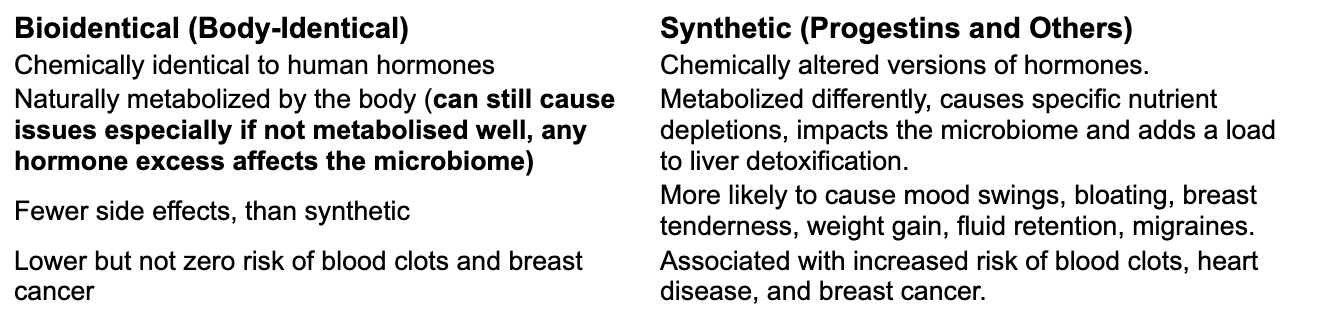
Bioidentical vs Synthetic Hormones: What’s the Difference?
People to look out for in this space:
Lara Briden: Why Perimenopause Is Not About Aging
Jerilynn Prior: Dr. Jerilynn Prior, a leading endocrinologist with over 45 years of experience in women’s reproductive health
Listen To Your Body
- Incorporate key nutrients like magnesium and taurine – this is corner stone in any Healthy Perimenopause tool kit.
- Prioritise rest, nourishment and self-compassion
- You’re not losing your mind – you’re just becoming a wiser version of yourself. And with the right tools, this transition can become a transformation.
- Always work with a practitioner who understands both hormones and whole-body health
Need help navigating your hormone journey? Reach out to a Perpetual Wellbeing naturopath for personalised support because every woman’s perimenopause is unique, and you deserve a plan that’s just as individual as you are.
We offer Naturopathy and Nutritional Medicine consultations
at 2 convenient locations, Brisbane CBD and Kenmore as well as online consultations.